

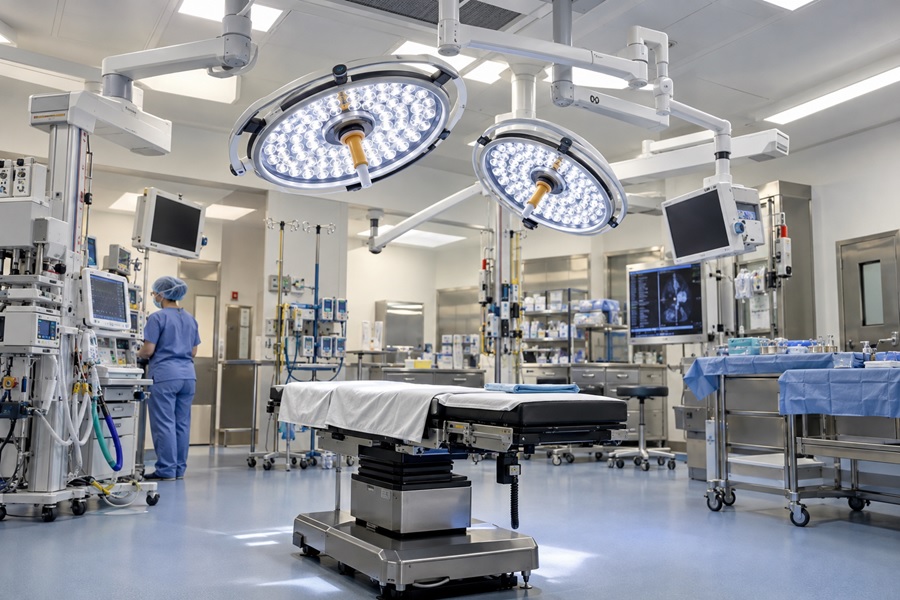
Lighting in an operating room is part of the clinical infrastructure that supports visibility, staff movement, equipment positioning, and procedural consistency. For healthcare facilities, selecting operating room lights therefore involves more than comparing fixture specifications or purchase prices.
The lighting system must work within the physical design of the room while supporting the needs of surgeons, nurses, anesthesia teams, and other clinical staff. It must also remain practical to operate, maintain, and service throughout its expected life.
Facility managers, clinical engineering teams, and procurement professionals can make more informed decisions by considering how lighting will perform as part of the complete operating environment.
Start With Illumination Quality and Surgical Visibility
The primary purpose of surgical lighting is to provide clear, consistent illumination of the operative field. However, maximum brightness alone does not determine whether a lighting system is suitable.
Facilities should consider how evenly light is distributed across the working area and whether clinicians can adjust illumination to suit different procedures. Colour rendering is also important because clinical teams need to distinguish tissue characteristics and subtle visual differences accurately.
Heat management is another consideration. Modern operating room lights are designed to deliver high levels of illumination without creating unnecessary heat around the surgical field or clinical team.
Controls should also be straightforward. Staff may need to adjust intensity, positioning, or other settings during a procedure, so those adjustments should be intuitive and accessible without disrupting workflow.
Evaluations are most useful when they focus on how the complete lighting system performs in realistic clinical conditions rather than relying on a single technical measurement.
Evaluate Shadow Control and Positioning
Operating room environments contain multiple people and pieces of equipment that can interrupt a light path. Surgeons, assistants, cameras, booms, monitors, and other devices may all move around the patient during a procedure.
Effective shadow control helps maintain visibility when one or more members of the surgical team are positioned between a light source and the operative field. Facilities should consider how a lighting system manages these interruptions and whether multiple light heads are required for the procedures performed in the room.
Positioning is equally important. Light heads should move smoothly and remain stable once positioned. Staff should be able to make adjustments without excessive force or repeated repositioning.
The range of movement should also suit the dimensions and layout of the room. A lighting configuration that performs well in a large operating theatre may not be appropriate for a smaller procedural space with limited ceiling clearance.
Clinical teams can provide valuable input during this stage because they understand how lighting must move throughout actual procedures.
Consider Room Configuration and Equipment Integration
OR lighting cannot be evaluated independently from the other systems installed in the room. Ceiling-mounted surgical lights often share overhead space with equipment booms, imaging systems, monitors, ventilation components, and other infrastructure.
Before selecting a system, planners should review ceiling conditions, mounting requirements, clearances, and the movement paths of other equipment. The objective is to prevent conflicts that could restrict positioning or create inefficient workflows.
Room purpose also matters. A general operating room may require a different lighting configuration from a room designed for orthopaedic, cardiovascular, minimally invasive, or other specialized procedures. Some rooms may require multiple light heads, while others may place greater emphasis on flexibility or integration with additional equipment.
Renovation projects introduce further considerations. Existing structural conditions and ceiling systems may limit mounting options or require modifications before new surgical lighting can be installed.
Reviewing these factors early can help facilities avoid selecting equipment that performs well technically but does not integrate effectively with the physical room.
Match the Lighting System to Clinical Workflow
Procedure type, room configuration, mounting requirements, and staff movement should all influence the final lighting configuration. A useful evaluation therefore considers how the system will support the complete operating room workflow rather than focusing only on the fixture itself.
Facilities can benefit from gathering input from surgical staff, clinical engineering, infection prevention, facilities personnel, and biomedical teams before finalizing requirements. These groups may identify practical issues involving positioning, cleaning, maintenance access, control placement, or equipment interaction that are not obvious from product specifications.
For Canadian healthcare organizations reviewing available configurations, ValleyMed provides information on operating room lighting solutions that can serve as a practical reference when comparing lighting arrangements against procedural and room requirements.
The goal is to select a system that fits the way the room will actually be used. A technically capable lighting system may still create operational problems if staff must repeatedly reposition fixtures, work around restricted movement, or adjust their normal workflow to accommodate the equipment.
Plan for Cleaning, Service, and Long-Term Support
Medical lighting should also be assessed from a lifecycle perspective. Operating room equipment is expected to remain dependable over many years, making serviceability and maintenance important procurement considerations.
Facilities should examine how easily exposed surfaces and handles can be cleaned according to established infection prevention practices. Components that require routine inspection or replacement should be accessible to biomedical and facilities teams without creating unnecessary disruption.
Service support should also be considered before purchase. Questions about replacement parts, technical assistance, preventive maintenance, warranties, and expected component availability can affect the long-term value of the system.
Standardization may be relevant for healthcare organizations managing several operating rooms or facilities. Using similar lighting platforms across multiple rooms can simplify staff familiarity, spare-parts planning, and maintenance procedures, although room-specific clinical requirements should remain the priority.
Selecting OR lighting is ultimately an infrastructure decision involving clinical performance, room planning, workflow, and long-term operations. By evaluating illumination quality, shadow control, positioning, equipment integration, and service requirements together, healthcare facilities can choose lighting systems that support both surgical teams and the practical demands of operating room management.