

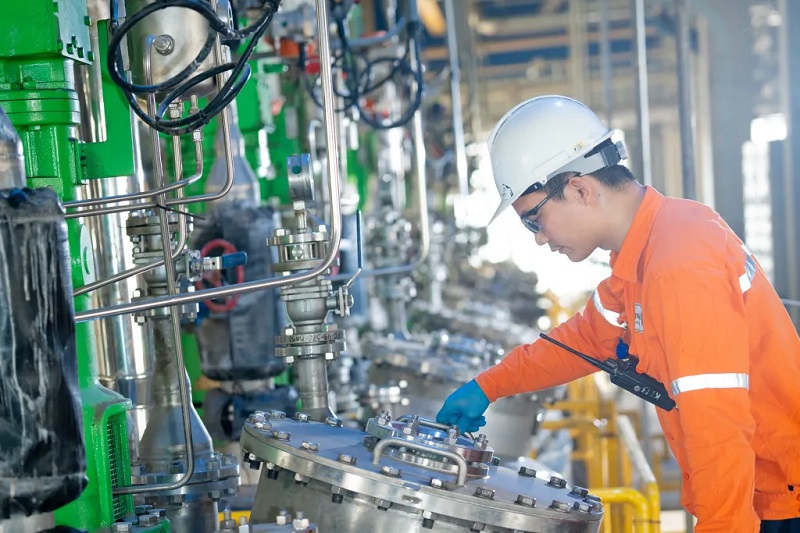
For more than a century, industrial construction adhered to an unyielding formula. Heavy industrial facilities, distribution centers, and manufacturing plants were built using standard structural steel, conventional poured concrete, and asphalt envelopes. These materials were predictable, inexpensive, and structurally adequate. However, the operating environments within modern industrial spaces have changed drastically. Automated logistics hubs now house multi-tier robotic racking systems requiring razor-thin floor tolerances, advanced manufacturing plants produce extreme chemical and thermal loads, and commercial enterprises face strict regulatory pressures to lower the embodied carbon of their facilities.
Relying on legacy building materials to solve modern industrial challenges has created an expensive maintenance bottleneck. Industrial facilities age prematurely under chemical exposure, moisture intrusion, and repetitive dynamic loads, costing facility operators billions in downtime and repairs.
To bridge this operational gap, materials science has entered the job site. Advanced building materials are transforming modern commercial construction from passive, sacrificial enclosures into active, resilient assets that cut lifecycle costs, lower carbon footprints, and accelerate project delivery.
Next-Generation Concrete: Self-Healing Matrices and Carbon Mineralization
Concrete remains the most consumed manufactured substance on Earth, but it carries two major vulnerabilities: high embodied carbon and a susceptibility to micro-cracking. Once microscopic fissures form in standard concrete slabs, moisture, salts, and industrial chemicals seep in, rapidly corroding the steel rebar reinforcement within.
To combat this deterioration, material engineers developed bacterial self-healing concrete. This technology mixes dormant bacterial spores alongside encapsulated nutrient media directly into the concrete mix during batching. These spores remain dormant for decades within the dry concrete matrix. The moment a crack forms and moisture penetrates the slab, the bacteria wake, metabolize the surrounding nutrients, and precipitate limestone crystals directly within the fissure. The crack seals itself autogenously before water can reach the interior reinforcement, preventing moisture intrusion and extending the operational lifespan of industrial foundations and slabs.
Simultaneously, carbon-mineralized concrete is tackling embodied emissions. By injecting recycled carbon dioxide into the concrete during the mixing process, the carbon undergoes a chemical transformation into solid mineralized calcium carbonate. These nano-scale minerals fill microscopic voids within the matrix, improving the compressive strength of the cured concrete by up to ten percent while permanently trapping the sequestered carbon. Because the resulting material possesses greater structural integrity, engineers can reduce the total volume of cement required in a mix without sacrificing structural performance.
Fiber Composites and Ultra-High-Performance Formulations
While concrete chemistry evolves, structural framing and reinforcement are undergoing their own composite revolution. In environments exposed to severe corrosive elements—such as chemical manufacturing plants, maritime cargo transfer stations, and wastewater treatment facilities—traditional steel rebar often fails within fifteen to twenty years despite protective epoxy coatings.
Enter fiber-reinforced polymers (FRP), particularly basalt and carbon-fiber composite rebar:
-
Corrosion Immunity: FRP rebar is chemically inert, eliminating the spalling, rust expansion, and structural concrete degradation that plague moisture-exposed facilities.
-
Exceptional Tensile Strength: Carbon-fiber composites offer tensile strength up to four times greater than standard structural steel at a fraction of the weight, significantly reducing dead loads on industrial structures.
-
Thermal and Electrical Non-Conductivity: Composite structural elements do not conduct electricity or create electromagnetic interference, making them essential for high-tech semiconductor fabs, specialized battery production plants, and automated data centers.
Alongside composite reinforcement sits Ultra-High-Performance Concrete (UHPC). Formulated with precise particle gradation, low water-to-binder ratios, and high-strength steel micro-fibers, UHPC achieves compressive strengths exceeding twenty-five thousand pounds per square inch. This extreme density allows engineers to design significantly thinner, longer-spanning structural members, freeing up interior floor plates for dynamic warehousing layouts without the visual and physical disruption of dense interior column grids.
Aerogels and Dynamic Envelopes: Redefining Thermal Efficiency
Industrial facilities feature cavernous cubic footprints that demand massive heating and cooling loads. Traditional insulation materials like fiberglass batts and expanded polystyrene require significant wall thickness to achieve adequate thermal resistance, consuming valuable usable interior square footage.
Modern industrial envelopes increasingly incorporate silica aerogel insulation. Consisting of over ninety percent air trapped in a nanoporous silica matrix, aerogel represents the lowest thermal conductivity of any known solid. Encapsulated into flexible blankets or thin insulation panels, aerogel provides up to four times the thermal resistance of traditional insulation at a fraction of the physical thickness. This enables distribution centers and temperature-controlled cold-storage facilities to maintain strict interior climate zones while preserving exterior wall clearance and internal cubic capacity.
Exterior claddings are also gaining dynamic capabilities through phase-change materials (PCMs):
-
Encapsulated micro-paraffins or bio-based salt hydrates are embedded within insulated metal panels and roofing underlayments.
-
During peak daytime operations, the PCMs absorb ambient heat and melt, storing latent thermal energy and keeping the interior building skin cool.
-
As evening temperatures fall, the materials solidify, releasing that stored heat back to the exterior.
This passive thermal buffering flattens peak heating, ventilation, and air-conditioning (HVAC) electrical loads, lowering utility demand charges during expensive peak hours and reducing the mechanical equipment capacity required to condition the facility.
Engineered Mass Timber in Industrial Logistics
Wood was historically dismissed for modern industrial applications due to concerns over structural deflection, dimensional instability, and fire hazards. However, the rise of cross-laminated timber (CLT) and glue-laminated timber (glulam) is upending that assumption across light manufacturing and regional fulfillment centers.
Mass timber relies on layered, kiln-dried structural lumber glued perpendicular to adjacent layers under immense hydraulic pressure. The resulting structural panels rival structural steel and reinforced concrete in load-bearing capacity while weighing up to seventy percent less.
In fire conditions, thick mass timber beams do not buckle like unprotected structural steel; instead, the exterior wood chars at a predictable rate, forming an insulating carbon layer that shields the structural core from thermal degradation.
From an operational standpoint, mass timber enables rapid off-site modular prefabrication. Whole wall and roof diaphragms are precision-cut using computer-controlled milling machines, shipped directly to the job site, and secured with structural fasteners in a matter of hours. This process eliminates long concrete curing windows, reduces on-site crew sizes, and shaves months off initial construction schedules, enabling commercial operators to achieve revenue-generating occupancy much earlier.
Calculating the True Lifecycle Value of Material Innovation
Adopting advanced building materials involves a noticeable hurdle: higher upfront procurement expenses. Specialized composite rebar, self-healing admixtures, and high-performance aerogels carry a cost premium over commodity construction supplies.
Yet evaluating construction materials solely on initial capital expenditure is an outdated procurement model. Industrial developers and corporate owner-operators evaluate materials through Total Cost of Ownership (TCO):
-
Eliminated Maintenance Interventions: Installing self-healing concrete and corrosion-free FRP rebar eliminates mid-lifecycle slab injections, bridge deck restorations, and structural remediation shutdowns.
-
Expedited Construction Velocity: Prefabricated composite panels and mass timber assemblies cut weeks of on-site labor, protecting budgets against weather delays and escalating labor rates.
-
Regulatory and Insurance Deductions: Facilities engineered with non-combustible composites, resilient thermal envelopes, and low-carbon materials frequently qualify for accelerated municipal permitting, favorable green building tax incentives, and lower property casualty insurance rates.
The future of industrial development is inextricably linked to materials engineering. As enterprises demand facilities that can withstand harsh operating stresses, protect expensive automated equipment, and comply with tighter carbon thresholds, the choice of raw materials becomes a defining business advantage. Moving past traditional steel and standard concrete allows commercial leaders to transform their facilities from basic storage containers into enduring, high-performance engines of corporate growth.
Comments are closed.